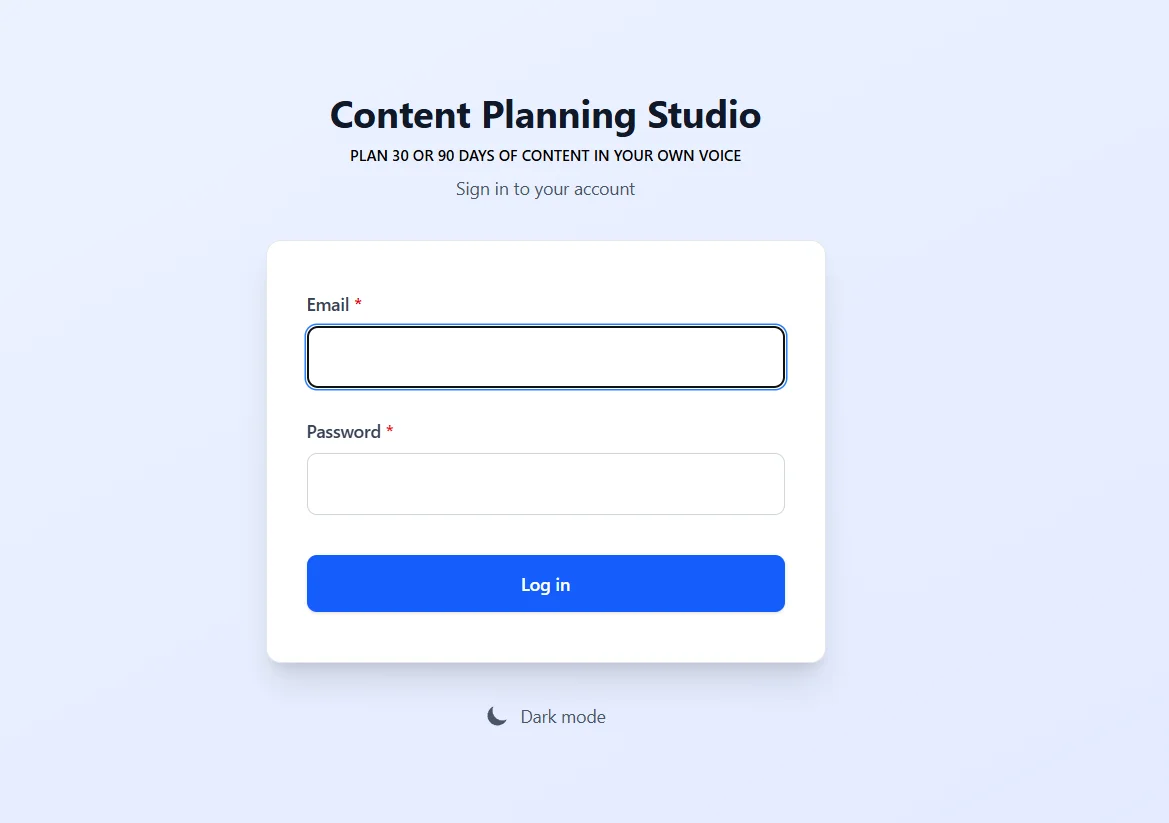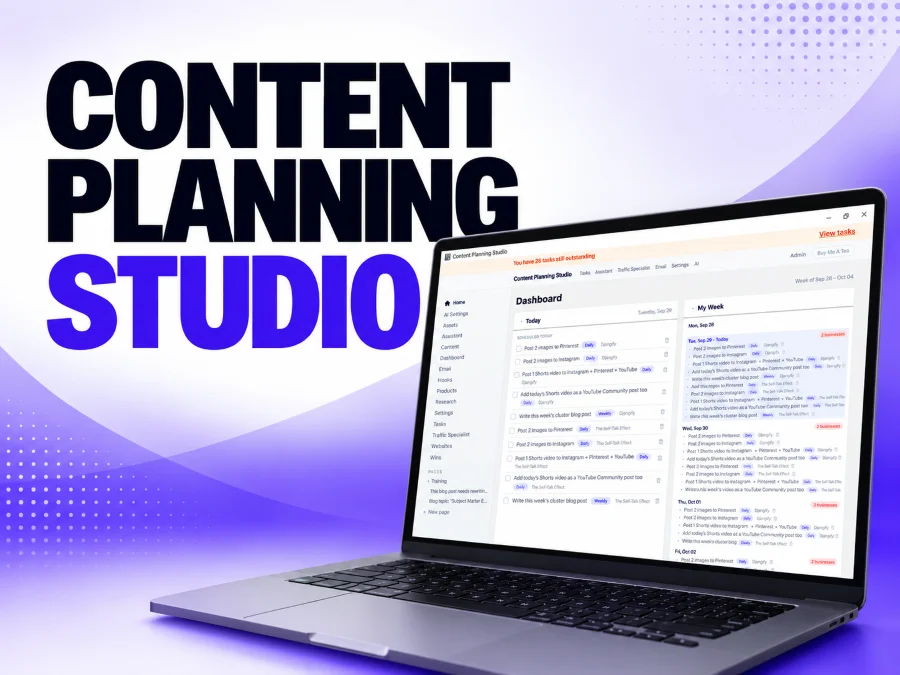
Content Planning Studio

Project Details

Content Planning Studio

A downloadable desktop app that plans 30 or 90 days of content for any website in your own voice, from your own assets, and turns content ideas into carousels.

Overview

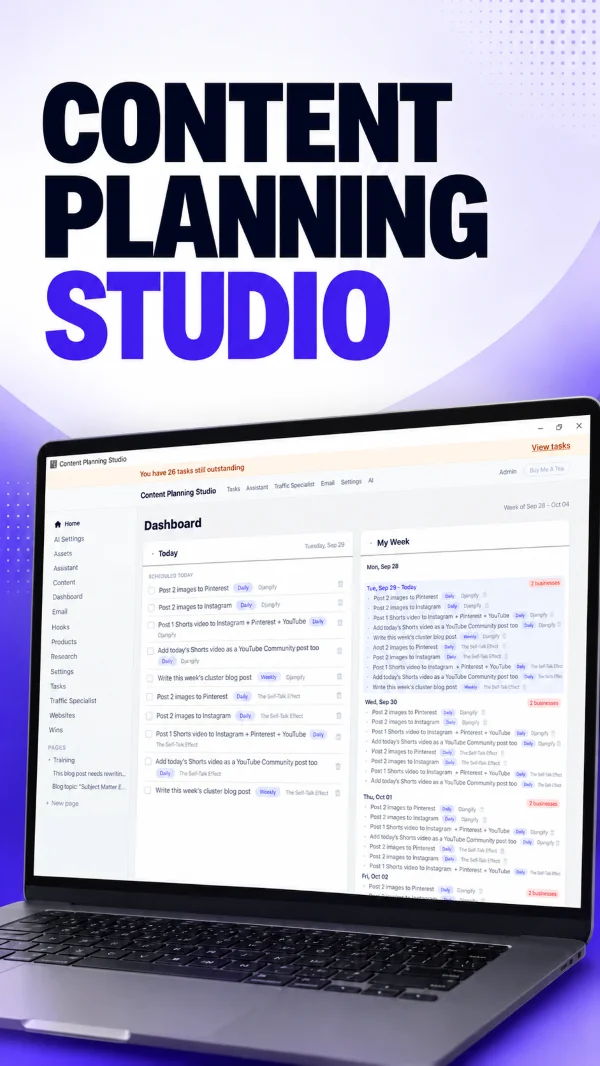
Content Planning Studio is desktop software that plans 30 or 90 days of content for a website, written in your own voice from the writing you have already done. Around the plan sits a full content workspace: a cross-business dashboard, tasks, a lightweight CRM, nestable notes, digital products, email sequences and newsletters, a content calendar and a carousel maker.

The whole thing lives on your own PC. You download it, it runs as a desktop app (a Windows .exe), and your data sits in a single SQLite file on your machine. There is no SaaS subscription, no third-party account, and nothing leaves your computer. It's built with Django, so a developer who prefers to run it from source or self-host it can, but that's entirely optional. For most people it's simply an app on their computer.

The plans follow a Know, Like, Trust framework. The 30-Day Content Plan covers one month for one product. The 90-Day Content Plan stretches the same idea across three linked 30-day phases, and drafts each later phase only after checking how much of the one before you completed.

If you run a Djangify shop, it connects directly to Djangify and imports your existing details, so you don't have to type everything in again. Your business information comes across and you can start planning straight away.

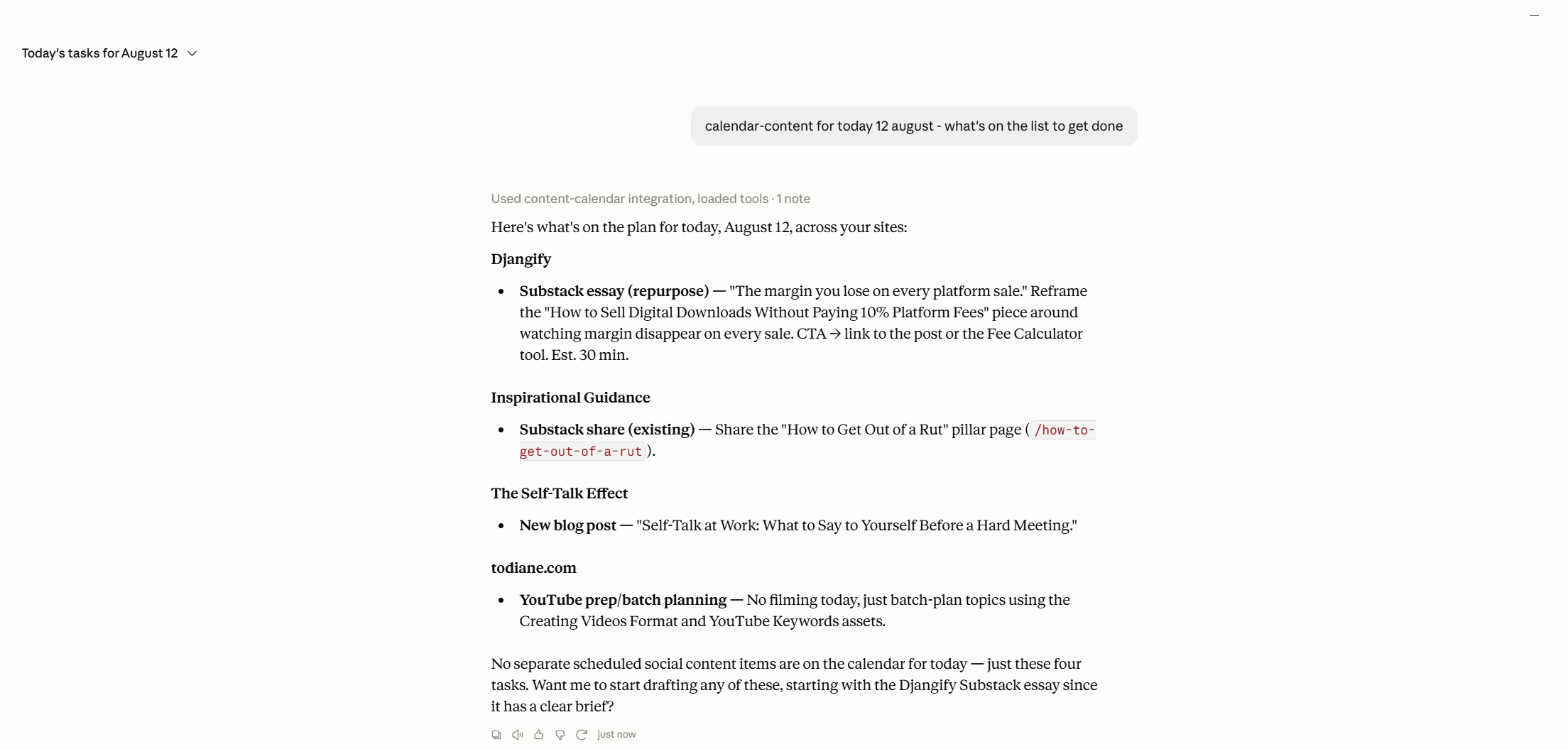
It also has an AI layer you can bring your own provider to (OpenAI, Anthropic or Google Gemini), with one setting driving every AI feature in the app. Because the calendar, planning and email tools are exposed as an MCP server, you can drive them from Claude Desktop on your own subscription instead of an API key if you prefer.

The source lives in a private GitHub repository. Content Planning Studio ships as a packaged desktop application rather than a hosted service, so there's no public live link.

I am currently the only person using it, as of October 2026. The idea is to offer it to Djangify owners as a way to plan the content for their shops.
Technical Details

Content Planning Studio is a Django 5.2 application packaged as a native desktop app. The same codebase runs two ways: as a self-contained Windows executable for everyday users, and as a conventional server deployment for anyone who wants to self-host.

Core features

  • Content plans: a 30-Day Content Plan chat that builds a day-by-day plan scaled to the hours you have, using a Know, Like, Trust framework, and drops it in as real, checkable tasks. A 90-Day Content Plan stretches the same idea across three linked phases and checks real task-completion data before drafting each new phase.
  • Voice from your assets: upload your own writing as assets, distil a reusable voice profile from it, and every plan and draft is written against that profile.
  • Carousels: turn a content item into a carousel of 3 to 7 slides from a short brief, laid out in the brand palette read from your assets, and exported as PNG images in a zip file.
  • Content calendar: every field from a content-planning spreadsheet in one record (date, pillar, type, topic, platforms, hook, caption, CTA, hashtags, cover media, published link, production and approval status), across calendar, board and table views, with major social platforms seeded out of the box.
  • Business management: a dashboard showing what's due today and this week (with a clash warning when two businesses land tasks on the same day), multiple websites tracked side by side, a task system with table, board and calendar views and recurring habit tasks, time-logging work sessions, a CRM with pipeline stages and follow-up reminders, nestable block-editor notes, and digital products with a sales log.
  • Djangify connection: for Djangify shop owners, the app connects to Djangify directly and imports your business details, so your data is carried over instead of re-entered by hand.
  • Email and newsletters: an Email Specialist that turns what you do into either an automated nurture sequence or a one-off newsletter, written in your voice and saved as a draft. The app never sends email; you paste drafts into your own provider.

AI engine

  • Bring your own provider: pick OpenAI, Anthropic or Gemini and swap between them without touching code. API keys are encrypted at rest with Fernet, derived from the app's SECRET_KEY, never stored in plain text.
  • Shared voice profile: distil a reusable voice from your own writing, applied everywhere content is generated.
  • Rewrite and de-AI-ify: paste existing copy and get it back with the phrasing that reads as AI-written stripped out, rewritten in your active voice.
  • Content frameworks: the same house instructions the assistant follows, so everything generated matches your framework (E-E-A-T blog playbook, social posts, the 30-day and 90-day content plans, and the email framework) rather than being improvised.

Claude Desktop (MCP)

The content calendar, 30-Day Content Plan, 90-Day Content Plan and Email Specialist tools are exposed as an MCP server. From Claude Desktop you can list, create, move and delete content items and tasks, write to your framework, rewrite copy in your voice, and build or check a 30-day or 90-day plan. On first launch the app registers itself with Claude Desktop automatically, with no config-file editing, and this path needs no API key, because Claude does the thinking on your subscription.

Stack

  • Django 5.2 and Django REST Framework
  • SQLite (a single file)
  • Tailwind CSS v4 (via @tailwindcss/cli, no Node build framework) with a little vanilla JS, no front-end framework
  • AI SDKs: openai, anthropic, google-genai; keys encrypted with cryptography (Fernet)
  • mcp (Model Context Protocol) for the Claude Desktop server
  • Gunicorn + WhiteNoise for server deployments; PyWebView + Waitress + PyInstaller for the packaged desktop .exe

Results

Content Planning Studio replaces a stack of separate tools (a planning spreadsheet, a task manager, a CRM, a notes app and a content scheduler) with one desktop app that keeps everything on the owner's own machine.

  • No subscriptions, no accounts: it runs locally as a Windows .exe, with all data in a single SQLite file, so there's nothing to sign up for and nothing leaving the computer.
  • Free AI, if you want it: driving the planning and content tools from Claude Desktop over MCP uses the owner's existing Claude subscription rather than a paid API key, so the AI features cost nothing extra.
  • Plans become real work: content plans don't just produce a document. They generate checkable tasks scaled to the time available, and the 90-day plan reads real completion data before moving on, so plans stay realistic.
  • One-button backup: a single click exports a complete, restorable snapshot of the whole database plus every uploaded file, so the owner always has an archive they control.

Scope: single user, one browser at a time. There are no multi-user accounts, no billing and no real-time collaboration. The Claude Desktop connection is local (stdio), working from the Claude Desktop app on the same machine.