I run my own sites using software I built myself, and I have had to learn search the slow way: by changing something, waiting, and seeing what happened and I know and understand how SEO works. The trouble is it keeps changing and it gets hard to keep up sometimes. I think people really do underestimates what it takes to get organic traffic now. It is not an easy task.
This post collects what I have written about SEO and AI search as a one-person business, from the technical basics to how I set up my own blog.
It is a record of what I tried on my own sites, not a description of how Google works. Search changes, so treat each post as a dated account and check it against what you see on your own site.
- Clear structure helps both search engines and AI tools understand a page.
- Cluster pages, FAQ snippets and schema markup are the three things I set up first.
- Content from your own experience is harder to copy than a general explainer.
- Publishing on your own domain keeps the work you do tied to your own site.
- You can do all of this alone, one page at a time.
What SEO and AI search mean for a one-person business
SEO is making your pages easy for search engines to find, read and rank. AI search readiness is the same job for tools like ChatGPT and Claude, which pull answers from pages they can understand quickly.
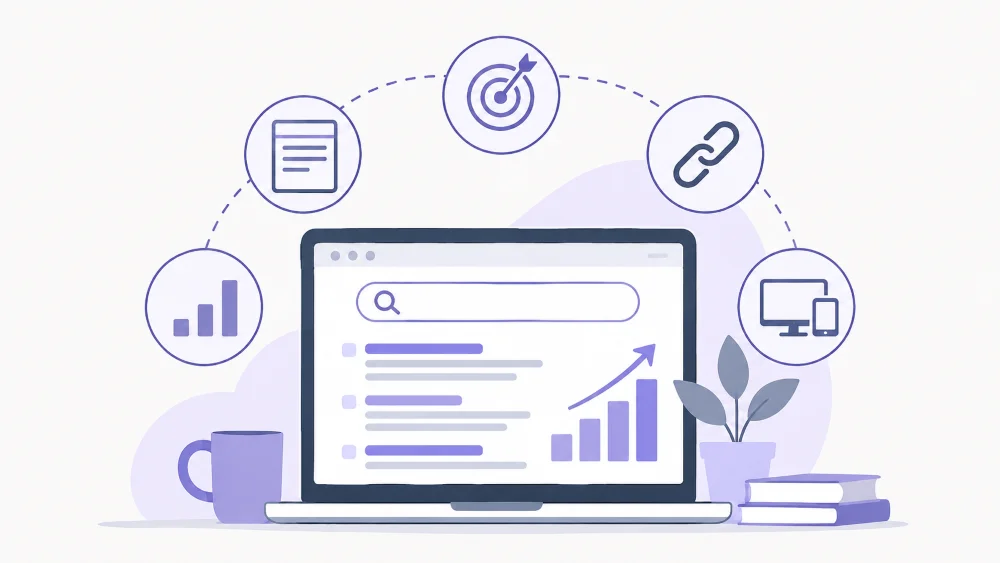
For a business of one, the work comes down to a few habits:
- Group related posts under one clear page (a cluster page)
- Answer real questions in short, direct snippets
- Add structured data so machines can read the page
- Keep the technical basics working: speed, links, indexing
- Write from what you have done yourself
General SEO advice
- Written for any site
- Often repeated across many pages
- Hard to tell what was tested
What I tested myself
- Done on my own sites
- Written up as I went
- Includes what did not help
Why I wrote it
I do not have a team or an agency, only AI as my assistant so, when something about search changed, I had to work out what it meant for my sites on my own, and writing it down was how I kept track.
These posts describe what I did and saw. They are not a promise that the same steps will give you the same result.
In May 2026 Google’s core update hit Inspirational Guidance. By early June, 170 of its articles were deindexed and by the end of June it was about 174 deindexed. I started rewriting them, two or three a day, and then saw what they were. Most were short ChatGPT articles I had pasted onto the site. So I deleted them all and nothing came back. When I moved the site onto Djangify v3, I also dropped the old products and posts and made new categories. The articles I care about now are the ones attached to my six cluster pages.
The same month, I searched my own name and the results were bad. Old accounts, a comment I left on Facebook ten years ago, and my own site on page 3. I spent four days on it, writing an about page, added schema to the about pages, and set up dianecorriette.com as a site that lists everything about me.
Then in October I changed my main domain from todiane.com to www.dianecorriette.com, because dianecorriette.com was the one that ranked for my name. While moving it, we found that todiane.com had never been added to Search Console and its sitemap had been returning a server error the whole time. That is probably why it never ranked, but I will never know for certain. By the end of October, a search for my full name put dianecorriette.com back at number one. It took a few months, but it came back.
What I took from it is that Google wants to know who is behind a site. I now read every AI draft before it goes up, add my own stories, and check that my sitemap actually opens.
Where to start
Three posts, in this order: what AI search readiness means, how to build a cluster page, and the technical basics underneath.
Decided to Find Out What AI Search Readiness Actually Means
Where I started when I set out to learn what AI search readiness means.
Read more →Build Cluster Pages (The Foundation of AI Search Readiness)
What a cluster page is and how it groups related posts.
Read more →Free tools
Try the Free Tools on This Site
I built a few small tools to help with planning content and ideas, including the Non-Commodity Content Builder, the Micro-App Idea Builder and the Software Idea to MVP Planner. They are free to use on this site.
See the free tools →Quick answers
Do I need to be technical to do SEO for my own site?
Most of the early work needs no code. Write short answers under clear headings, link related posts to each other, fix broken links and check in Search Console that your pages are indexed. The code parts, such as sitemaps and schema, can be handled by your site platform or an AI assistant, and a free testing tool will tell you whether they worked.
Is AI search different from normal search?
The main practical difference is what you measure. An AI tool may quote a passage from your page without sending anyone to it, so clicks alone understate your reach. Write each section so it makes sense on its own, state facts plainly, and watch for mentions and referrals as well as rankings. The same good structure helps with both.
Where should I publish my content first?
Publish on a site you own, then share a short version elsewhere that links back. Platforms can change their rules, shut down or lose your audience overnight, while a page on your own domain keeps working and keeps building your authority. One well-finished post on your own site is worth more than five scattered across other places.
Reflection
- Structure, short answers and structured data help both search engines and AI tools.
- Your own experience is the part nobody else can copy.
- Start with one cluster page and build from there.
Think about the questions people ask you most often. Does your site answer each one in a short, direct paragraph?
Write your answers here
- Which three questions do people ask you most?
- Which of them does your site already answer clearly?
- What is one page you can improve this week?