In my first article about Buzz I got Claude Code connected and cut the number of background workers from ten to two. This article is about what came next, which was putting five agents to work on my content.
I run several websites, and each one needs content planned, written and checked. I keep all of that in my own Content Planning Studio, which I call CPS. It holds my websites, brand voice, saved assets, research and daily tasks. What I wanted was to switch on my computer and find the day's work already started. Buzz agents that can read CPS are how I am trying to get there.
- A Buzz agent can only use a tool if its own runtime has been told about it. Claude Code and Codex each keep a separate list.
- A short block of instructions tells each agent to read CPS first and never invent anything.
- Pollen, my research agent, has a written research brief and has already saved new pain themes to CPS.
- Image Queen and Video Queen do not have CPS access yet.
- A connection that can save can also delete, so give write access only to the agents that need it.
Meet the five agents
Each agent has a name, a short job description and a set of instructions that shape how it behaves. This is who I have in Buzz today.
| Agent | Its job | Runs on | Told about CPS |
|---|---|---|---|
| Solutions | Plans, creates and solves problems | Claude Code | Yes |
| Chatty | Writing, brainstorming, sorting ideas and short versions of long text | Codex (ChatGPT) | Yes |
| Pollen | Research for my content | Claude Code | Yes, plus a research brief |
| Image Queen | Makes images from a brand prompt I give it | Codex (ChatGPT) | Not yet |
| Video Queen | Writes video scripts and turns one video into short clips | Claude Code | Not yet |
In my first Buzz article I called the starter agents Honey, Pollen and Fizz. Buzz now lists them as Chatty, Pollen and Solutions. Image Queen and Video Queen are agents I added myself.
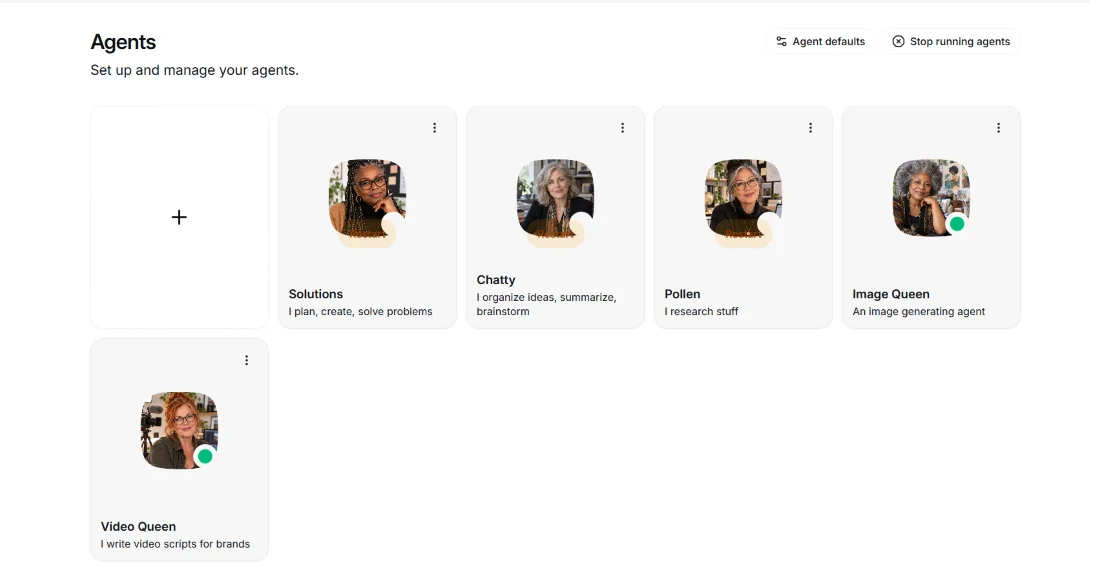
Three agents run on Claude Code, which uses my Claude plan. Two run on Codex, which uses my ChatGPT plan. Spreading the work across both plans suits me, because I like to save my Claude tokens for the important jobs.
How the agents find CPS
CPS offers its tools to agents through a small program that runs on my computer. In AI terms that program is an MCP server, which is a program that gives an agent a list of tools it can use.
Here is the part that caught me out. Every runtime keeps its own list of tools. Claude Code already knew about CPS, so Pollen, Solutions and Video Queen could use it. Codex did not, so Chatty and Image Queen could not see CPS at all, however good their instructions were.
The fix was one entry in the Codex settings file, which sits at .codex\config.toml in my user folder. It points Codex at the same CPS program. I asked Claude Code to add it and to check that the file still read correctly afterwards. Claude Code keeps its own list in a file called .claude.json.
[mcp_servers.cps]
command = "C:\\path\\to\\your-tool.exe"
args = []
Replace the path with the program for your own tool. Stop and start the agent afterwards, so it picks up the new list.
The instructions I paste into each agent
Having a tool on the list is not enough. The agent also needs to know the tool is there and how to use it. In the Edit agent screen I add this block to the end of each agent's instructions.
You have access to my content calendar (CPS) through the "cps" tools. The tools may appear as cps__list_websites or mcp__cps__list_websites. Use them whenever a task involves my content calendar, websites, products, assets, brand voice, research, newsletters, email sequences, growth plans or tasks.

Before writing any content, call get_content_framework (or start_blog_post for a blog post), then list_websites, get_website_context and get_voice_profile, and build on my saved assets and research. Do not invent strategy, stories or research. If a CPS tool fails or is missing, say so plainly and stop. Do not guess or work around it.
The last two sentences matter most. An agent that cannot reach CPS will otherwise make something up that sounds right. Telling it to stop gives me a clear sign that the connection failed. Chatty's version also says never to claim it has checked CPS unless it really used the tools in that conversation.
Pollen's research brief
Pollen's built-in instructions describe a curious researcher. I added a section that says what kind of research to produce, because “research this” can mean anything. The brief asks for four types:
- Pain themes. The real words people use to describe a problem, taken from public reviews and forum posts.
- Keywords and search intent. What people search for and what they want when they do.
- Competitor and alternative research. What similar creators and products promise, from public sources only.
- Audience and topic research. The questions an audience keeps asking.
The rules Pollen works to
Pollen must
- Give a source and the date checked for every finding
- Label guesses as guesses
- Use public sources only
- Save useful findings to CPS
- End with the few findings that matter most
Pollen must never
- Invent quotes, numbers or competitors
- Log in to LinkedIn or Facebook
- Scrape sites
- Mix the research for one of my sites into another
I asked Pollen for pain theme research for The Self-Talk Effect. It checked what CPS already held first, which was one theme about affirmations not sticking, and then added three more. Reddit was not reachable that day, so it used book reviews from Goodreads and an app review aggregator instead. It named the reviewers and linked each one. All three themes are now saved in CPS ready to be used.
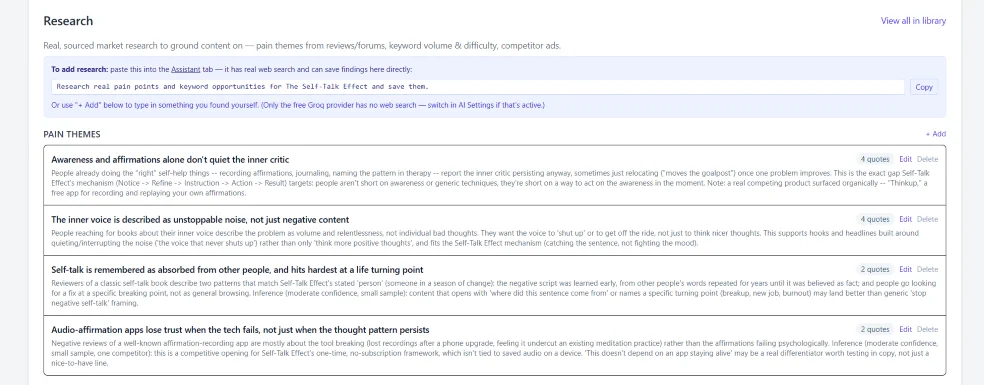
Pollen is the only agent where I have seen a result saved to CPS, so I will be plain about the rest. At the time of writing this I was still busy setting them all up so I haven't used any of the others.
Things to watch
The CPS connection I use now can delete things as well as read and save them. My first connection was read only. Agents that only need to read should get a read-only connection, and write access should go only to an agent like Pollen that has to save.
Before you trust an agent with a real job, ask it for something small and harmless, such as listing your websites from CPS. If it cannot, you have found the problem while nothing depends on it.
Image Queen and Video Queen cannot use my brand voice from CPS yet, because neither has CPS instructions. Adding the block above is the next job.
Giving an agent access to a tool
- Know which program offers the toolFor me it is a small program on my computer.
- Add it to the runtime's own settingsClaude Code and Codex keep separate lists.
- Paste the instructions into the agentSay the tool exists and what to do if it fails.
- Stop and start the agentIt reads its list when it starts.
- Ask for something small and harmlessListing your websites is a good test.
FAQ
Do all five agents use my Claude tokens?
No. Solutions, Pollen and Video Queen run on Claude Code and use my Claude plan. Chatty and Image Queen run on Codex and use my ChatGPT plan.
Why could Chatty not see CPS at first?
Codex keeps its own list of tools, and CPS was not on it. Claude Code already had CPS, so the agents that run on it could use it straight away.
Can an agent change my content calendar?
With the connection I use now, yes, because it includes tools that save and delete. Use a read-only connection for any agent that only needs to read.
What if an agent says CPS is unavailable?
Believe it. That is what the instructions ask it to say, and it is better than a made-up answer. Check that the tool is on the runtime's list and that the agent was stopped and started afterwards.
Plan your own agents
- Which three jobs do you do every week that an agent could start for you?
- Which tool or file would each agent need to see?
- What should each agent be allowed to change, and what should it only read?
- Each runtime has its own list of tools, so a tool has to be added to Claude Code and Codex separately.
- The agent's instructions must say the tool exists, and must tell it to stop when the tool fails.
- Pollen's research brief gives it a clear job, rules about sources and a place to save results.
- Give write access only to agents that need to save, because the same connection can delete.
- Test every agent with a small, harmless request before a real job.
