After Google's May 2026 core update I went into Search Console to find out why traffic on one of my sites had dropped. Over 100 of my articles had been deindexed. They were no longer in search results at all.
This post is my account of what happened, what I changed and what I do now. It covers E-E-A-T, branding and indexing from my own experience, so it includes the parts that went badly.
- Over 100 articles on one of my sites were deindexed after the May 2026 update.
- They were AI-written articles from 2025 that I had pasted in without adding anything of my own.
- The articles had not changed. What changed was how much Google would put up with that kind of content.
- A smaller set of articles worth reading is better than a large set that is not.
- AI drafting still has a place, as long as every piece gets something from real experience before it is published.
- Google's own help pages say how to check what is indexed, what E-E-A-T means and how long recovery can take. They are summarised below.
What happened
The deindexing happened on a site of mine, Inspirational Guidance, and I wrote about it as it unfolded. When I looked in Search Console, over 100 articles were listed as deindexed. If someone had the direct link they could still read them, but they were not showing up in search, so they were getting no clicks from it.
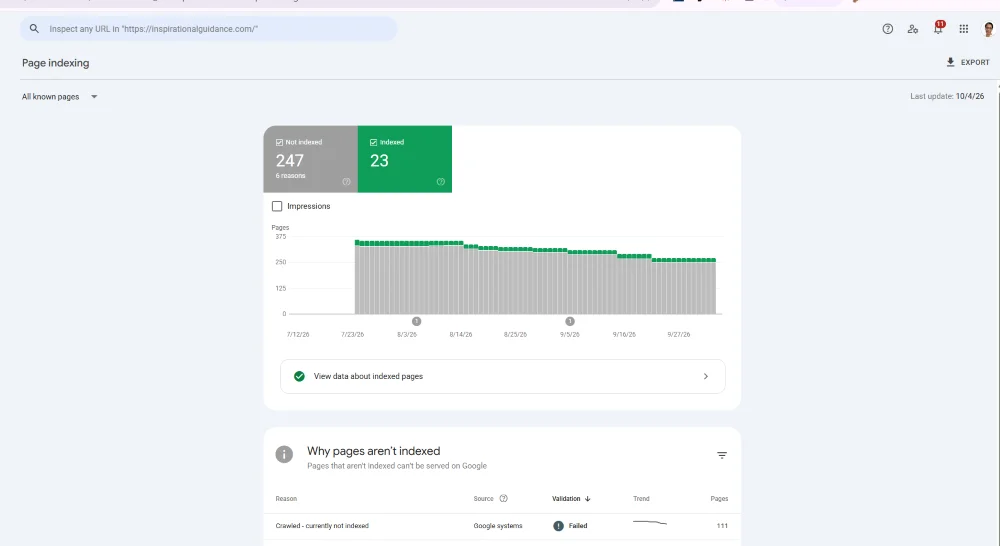
Why it happened, as I understand it:
- In 2025 I used AI to write articles and pasted in whatever it gave me
- Looking back, many were brief and could have been published on any similar site
- None of them contained my own perspective or a story of mine
- Nothing about them was spam, but it was the pattern the update was built to catch
What I did in 2025
- Pasted in AI drafts
- Published without much editing
- Wrote a lot of short articles
What I do now
- Use AI for a draft, then rewrite it
- Add a real detail or story before publishing
- Publish fewer articles worth reading
What I changed
I deleted many of the weaker articles in batches, and I am leaving the indexed ones as they are. A Google AI answer told me it is better to have 20 articles worth reading than 150 mediocre ones, and I decided to accept that. Going forward, I write each article with something in it that only came from doing the thing, and I read it back before it goes live.
I am waiting to see what Google decides next. The site is not a main priority for me right now, so I may not recover it.
How to check what Google has indexed
Before you change anything, find out what is actually missing. Google's own help page for the Page indexing report says a site with fewer than 500 pages probably does not need the report at first, and suggests a simple search instead. Here is the order I would follow.
- Search for your site. Type
site:yourdomain.cominto Google and look for your key pages. If they appear, they are indexed. - Open the Page indexing report in Search Console. Look at the table called "Why pages aren't indexed", then click a row to see the affected URLs.
- Inspect one URL. Click the inspect icon next to a URL, or paste it into the URL Inspection tool, and read the crawl and indexing details. The result shows the version Google last indexed. Press Live Test to see the page as it is now.
- Read the status before you react. "Crawled - currently not indexed" means Google visited the page and chose not to add it to the index. Google says this is common and does not always point to a problem, but for pages that matter it is worth investigating.
Not every URL in the "not indexed" list needs fixing. Duplicates, pages with a noindex tag, redirects and pages that no longer exist are often listed there for good reasons. Focus on the pages you want people to find.
Sources: Page indexing report, Search Console Help and URL Inspection tool, Search Console Help.
What Google says about AI content and E-E-A-T
E-E-A-T stands for experience, expertise, authoritativeness and trustworthiness. Google's guidance on helpful content says trust is the most important of the four. It also says E-E-A-T is not a direct ranking factor: Google's systems use a mix of signals that can identify content with strong E-E-A-T.
The same page gives three questions to ask about your own content:
| Question | What Google asks | What I would check |
|---|---|---|
| Who | Can readers tell who created the content? | A byline that links to a page about the author, where readers would expect one |
| How | Is it clear how the content was made? | A short note on how AI was used, when readers would wonder |
| Why | Was it made mainly to help people? | That the article exists for a reader, not just to fill a search result |
On AI specifically, Google says generative AI can be useful for researching a topic and adding structure to original content. It also says that using AI to produce many pages without adding value for users may break its spam policy on scaled content abuse. That describes what I did in 2025. Google's guide to generative AI search features adds that you should create content from what you know about the topic and avoid repeating what others have said or what an AI model could easily produce.
Sources: Creating helpful, reliable, people-first content, Guidance on using generative AI content on your website and Optimizing for generative AI features on Google Search.
How long recovery can take
I am still waiting, so here is what Google says rather than what I have seen. The May 2026 core update began rolling out on 21 May 2026, according to the Google Search Status Dashboard. Google's core update page gives this advice:
- Wait at least a full week after the update finishes, then compare that week with the week before the rollout began
- Some changes can show within days, but Google's systems may take several months to confirm that a site consistently produces helpful content
- If you see no change after a few months, the next core update may help
- There is no single fix. Avoid quick fixes, improve content in meaningful ways and treat deleting content as a last resort
- Do not change content that is already doing well
That last point about deleting is worth thinking about before you do what I did. If an article is thin, improving it with real experience may be a better first step than removing it.
Source: Google Search core updates.
Where to start
What Happened When Google Deindexed Over 100 of My Articles
What I saw in Search Console after the May 2026 update.
Read more →Use AI, Don't Just Accept It: How These Articles Actually Get Written
The habit that protects against publishing generic AI content.
Read more →Where Should You Publish Your Content? Why I Start With a Blog on My Own Domain
Why a blog on your own domain comes first.
Read more →SEO for a One-Person Business in 2026
The SEO basics I keep to as a one-person business.
Read more →Content That Builds Authority for Life Coaches
Writing that shows your experience to readers and search engines.
Read more →Building With AI as a One-Person Business
How I use AI in my own work and where I still do it myself.
Read more →Write pages only you could have written
Give Readers Something to Do
Interactive Content Blocks helps you add something a reader can do on the page, such as a checklist or a writing box, so your articles are more than a block of text. It is the pack I use on my own sites.
See Interactive Content Blocks →Question
How can I tell whether an AI draft is ready to publish?
Give every draft a test before it goes live. Ask whether the same paragraph could appear on a hundred similar sites unchanged. If it could, add something only you have: a date, a number, a mistake you made or a screenshot. Read it aloud, and delete any claim you could not back up if a reader asked how you know.
Reflection
- Over 100 of my articles were deindexed after I published AI drafts without adding my own experience.
- I deleted the weakest and kept the indexed ones, and I now add something real to every article.
- Google says recovery can take several months and that deleting content should be a last resort.
- I do not know whether the site will recover.
Open your most recent article. Is there anything in it that only you could have written?
Write your answers here
- What in your last article could only have come from you?
- Which article would you not miss if it disappeared from search?
- What is one small step you can take this week?