How do you know whether offline-first software is actually the right approach for a project or tool?
Offline-first is not a moral stance and it is not automatically better software, because it is a design choice with real trade-offs. Many people treat it either as a default answer or as something that has to be defended, when it is simply one architectural option among several and one that suits certain kinds of problem unusually well.
This article explains when offline-first makes sense, when it does not, and how to tell the difference before you build or commit.
- Start with the work, not the technology. Offline-first suits individual, ongoing, private and long-term work.
- It is a poor fit when many people need live access to the same data, or when value depends on scale.
- Choosing the cloud just in case adds complexity and running costs early, and it lowers user trust.
- Define a no-internet baseline first, then make every online feature earn its place against it.
Start With the Nature of the Work
The most important question is not technical but functional: what is the user actually trying to do? Offline-first suits work that is individual rather than collaborative, ongoing rather than transactional, private rather than public-facing and long-term rather than disposable. If the core activity happens alone, on one machine, and benefits from continuity, offline-first is often a strong fit, but if it needs constant coordination with other people, it may not be.
Strong Signals That Offline-First Is a Good Fit
Offline-first tends to be the right choice when the user is the main or only operator, the data has long-term value, reliability matters more than immediacy, internet access is unreliable or incidental, and the tool is used often but quietly. That is why it works so well for personal finance and bookkeeping, writing, journaling and research, learning and revision tools, small internal business systems and creative production workflows, because in these cases the cloud rarely adds anything essential.
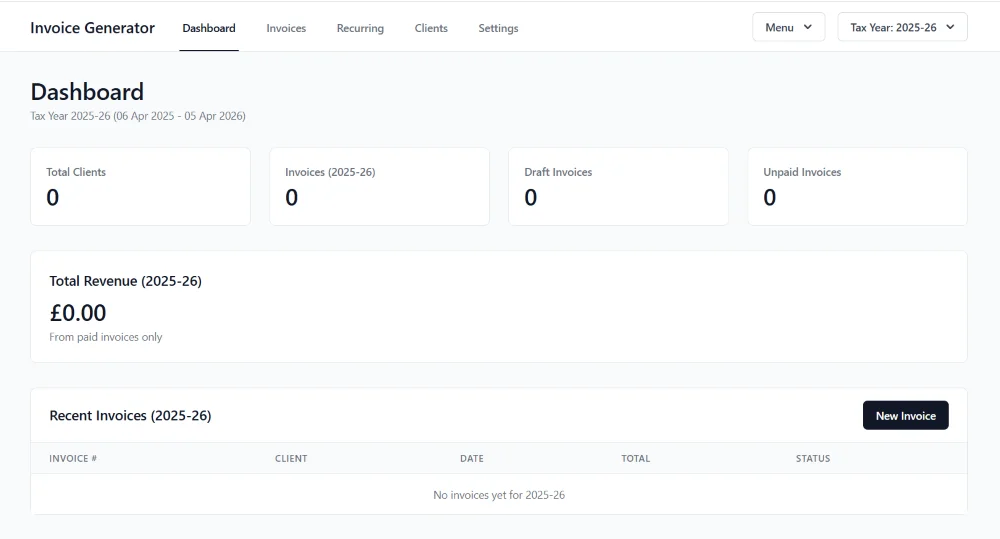
The free tools in my shop follow this pattern. Desk Ledger keeps bookkeeping records on your own computer, Invoice Generator keeps clients and invoices there too, and Pipeline does the same for contacts and follow-ups. All three run on Windows without a cloud account, and none of them needs to share live data with anyone else.
Weak Signals That Offline-First May Be the Wrong Choice
Offline-first is usually a poor fit when several people need real-time access, when data has to be shared instantly, when live updates are central to the experience or when the product's value depends on scale. Social networks, live collaboration tools, marketplaces and messaging systems all fall into this group, and for them a cloud-first design is often justified, not because it is fashionable but because the problem genuinely requires it.
Offline-first fits
- One main user
- Data with long-term value
- Reliability over immediacy
- Poor or incidental internet
Cloud-first fits
- Many people at the same time
- Data shared instantly
- Live updates at the center
- Value that depends on scale
The Cost of Choosing Cloud “Just in Case”
Many projects default to a cloud design in case they need it later, and that creates hidden costs: more technical complexity, higher running overhead, earlier pressure to charge for the product and lower user trust. Offline-first lets you build something useful without committing to infrastructure, scaling or ongoing service obligations, and for independent developers and small teams that restraint can decide whether a tool gets finished or abandoned.
Offline-First as a Constraint That Improves Design
Design constraints are usually described as limits, but in practice they sharpen thinking, and offline-first makes you ask what is essential, what can be simplified and what the user actually needs. Removing always-on connectivity often leads to cleaner data models, fewer features that are better connected to each other, more predictable behavior and a lower maintenance load, and many developers find their product improves when offline-first is a requirement from the start and not an afterthought.
Two Practical Tasks
Run the offline-first test
Think of a current project or idea and rate each statement honestly. Then ask yourself which features would break completely, which would only become less convenient, and whether collaboration is essential or optional.
- The tool would still be useful with no internet access.
- One person is the main user.
- The data has long-term value.
- Reliability matters more to me than instant updates.
- Nobody needs to see changes the moment I make them.
- Cloud-first may fit betterLook closely at what the tool needs from other people and from live data before you commit.
- A hybrid could workBuild the core offline and add carefully chosen online features around it.
- Offline-first deserves serious considerationMost of the value survives without a connection.
Define the no-internet baseline
- Runs entirely locallyNothing in the core job needs a connection.
- Keeps all data on the deviceThe user can find it and back it up.
- Has no account systemNobody has to sign up to use it.
- Solves the core problem from start to finishIf it is not useful at this level, the problem may not be well understood yet.
Hybrid Models and Transitional Paths
Offline-first does not mean offline forever, because some tools grow into offline-first with optional export, offline-first with manual sync or offline-first with carefully limited cloud features. What matters is the order, since starting offline-first preserves control and clarity, and adding connectivity later is easier than removing it once assumptions have spread through the whole system.
The Long-Term View
Offline-first software ages differently, because it depends less on outside services and so breaks less often, needs fewer emergency fixes, stays usable for longer and asks for less ongoing attention. For tools that support thinking, record-keeping or personal systems that longevity is not a bonus but the whole point.
Choosing offline-first is not about rejecting modern infrastructure, it is about seeing when that infrastructure is unnecessary. When the problem is personal, durable and self-contained, offline-first is often the most honest and sustainable approach, not because it is simpler to build but because it respects the nature of the work being done.
- Choose offline-first when the work is individual, private, ongoing and long-term, and choose cloud-first when many people need live access to shared data.
- Choosing the cloud just in case adds cost and complexity before you know you need it.
- A no-internet baseline gives you a clear reference point for judging every later online feature.
- Hybrid paths are fine, as long as you start offline and add connectivity second.
What Is Offline-First Software?
A clear definition, and how it differs from works offline.
Read more →The Journey from Offline-First to Local-First
What changes when you add sync to an offline-first tool.
Read more →